Supporting Reading at Home: Phoneme–Grapheme Mapping Made Simple
Many parents want to help their children with reading but are unsure what to do when their child struggles with a word. It is common to encourage children to look at the picture, guess the word, or memorize it for next time. While those strategies may help in the moment, strong readers rely on a different process. They learn to connect the sounds they hear in words to the letters that represent those sounds. One helpful way to think about this is that children learn to connect the sounds in spoken words to the letters they see in print. Educators often refer to this process as phoneme–grapheme mapping. While the term may sound technical, the idea behind it is simple and powerful.
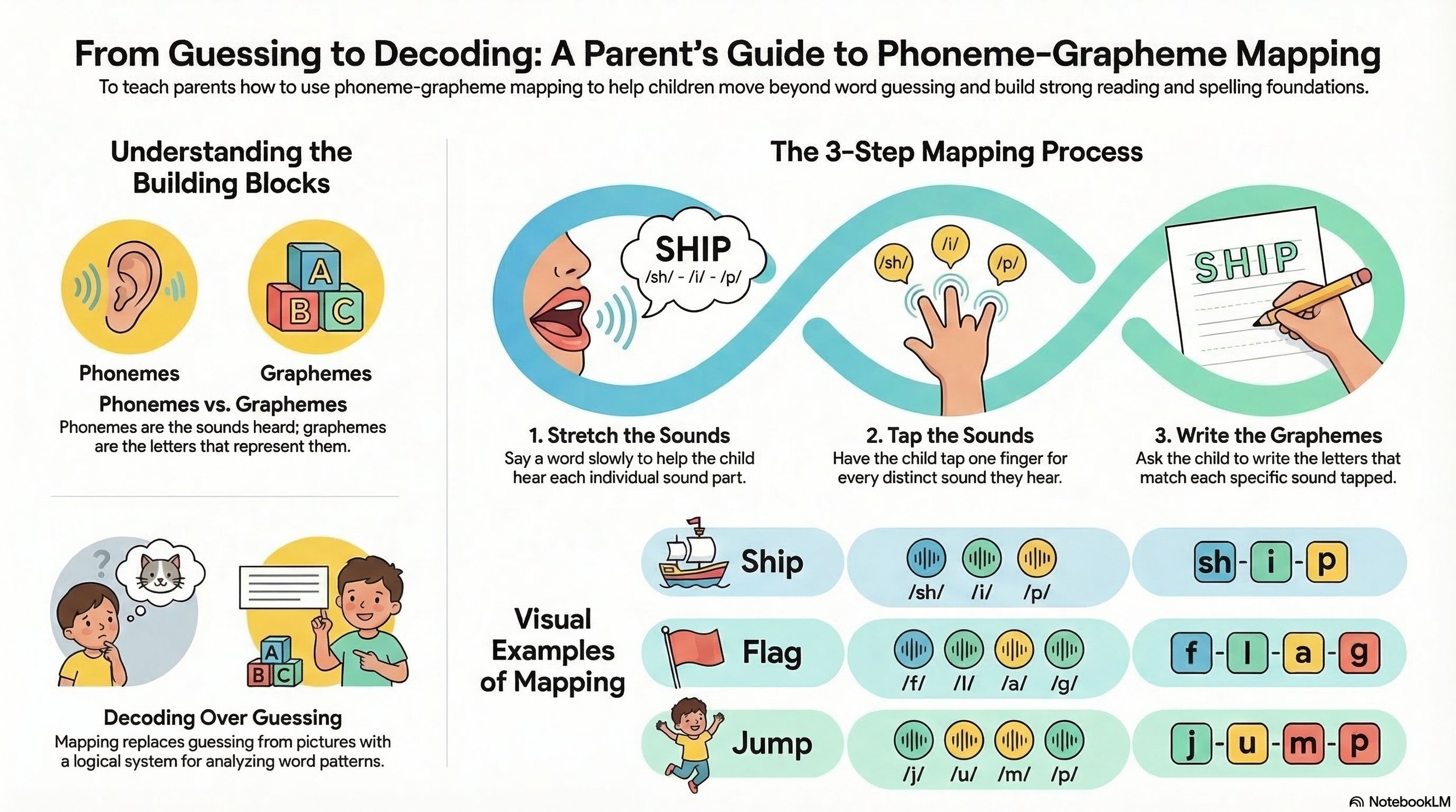
A phoneme is a sound in a word. A grapheme is the letter or group of letters that represent that sound. When children learn to connect sounds to letters, they begin to understand how words work. For example, in the word ship, we can hear three sounds: /sh/, /i/, and /p/. Each of those sounds connects to letters on the page. Helping children notice and map those sounds to letters supports both reading and spelling. This process matters because reading is not based on memorizing words alone. When children practice mapping sounds to letters, they strengthen their ability to decode unfamiliar words, spell words more accurately, and recognize words more automatically over time.
The good news is that parents do not need special training to support this skill. A few simple activities can help children practice connecting sounds and letters in meaningful ways:
One activity is stretching the sounds in a word. Choose a simple word such as map and say it slowly, emphasizing each sound: /m/ /a/ /p/. Ask your child to repeat the sounds with you. This helps children hear the individual parts of a word.
Another activity is tapping the sounds. As your child says each sound in a word, they can tap one finger for each sound they hear. For example, the word flag includes four sounds: /f/ /l/ /a/ /g/. Tapping helps children break words into manageable parts and builds awareness of how sounds are organized within words.
After identifying the sounds, children can connect them to letters by writing the grapheme that represents each sound. If your child stretches the word jump into /j/ /u/ /m/ /p/, they can write the letters that match those sounds. This activity strengthens both reading and spelling because children are learning how sounds and letters work together.
When practicing at home, it is helpful to start with simple words that are easy to hear and stretch. These activities only take a few minutes and can easily fit into reading time, homework time, or even a quick moment during the day. When children understand how sounds connect to letters, reading becomes less about guessing and more about problem solving. Phoneme–grapheme mapping helps children see that words follow patterns they can learn and apply. With consistent support and practice, children begin to approach reading with greater confidence and independence.
I have included a simple phoneme–grapheme mapping word list that can be used at home. The list includes beginner words that are easy to stretch into sounds and slightly longer words for continued practice.