Supporting Literacy Instruction for Alternative Certification Teachers
Alternative certification teachers bring valuable strengths into classrooms, including content knowledge, life experience, and a deep commitment to students. At the same time, many enter teaching without extensive preparation in literacy instruction, which can make reading and writing feel overwhelming, especially in classrooms where students arrive with diverse needs.
Literacy instruction includes many interconnected pieces, and it is easy to feel pressure to “fix everything” at once. The goal, however, is not to master every aspect of literacy instruction immediately. Effective literacy teaching develops over time, just as teacher confidence does. What matters most is knowing where to begin and understanding how instruction can grow intentionally.
For alternative certification teachers, the most important starting point is strong Tier 1 instruction built on clear routines. Predictable structures for reading and writing create stability for students and teachers alike. When students know what to expect during literacy time, teachers are better able to focus on instruction rather than management. Strong routines create consistency so teachers can focus on improving their practice.
Another essential focus is understanding how reading and writing support one another. Literacy is not two separate blocks of instruction. Writing helps students process text, clarify thinking, and strengthen language. Short writing tasks, such as responding to reading or revising sentences, support comprehension and vocabulary development. At the same time, these tasks should connect to explicit instruction in the writing process. Students need to be taught how to plan, draft, revise, edit, and publish so they understand how ideas develop over time. Teaching the writing process gives structure to writing instruction and helps students see writing as a meaningful, purposeful act rather than a series of isolated tasks.
Alternative certification teachers should also feel confident addressing decoding and word-level skills, even beyond the early grades. Phonics instruction does not end in kindergarten. Many students in upper elementary grades continue to struggle with decoding, which affects fluency, comprehension, and writing. Modeling how to break apart unfamiliar words, identify syllable patterns, or analyze word parts during instruction helps students develop strategies they can use independently. This work does not require a separate phonics block; it can be embedded naturally into reading, spelling, and writing.
Rather than trying to implement every strategy at once, alternative certification teachers benefit most from viewing literacy instruction as a roadmap. Establish routines first. Teach reading and writing in connected ways. Make decoding visible. Build writing instruction intentionally over time. These priorities create a strong foundation that can be refined and expanded as teachers gain experience and confidence.
Finally, it is important to remember that alternative certification teachers do not need perfection; they need support. Literacy instruction is complex, and growth happens through reflection, collaboration, and access to clear, research-informed guidance. When teachers are given permission to focus on what matters most, instruction becomes more coherent and students benefit from consistent, purposeful literacy experiences.
Supporting alternative certification teachers is not about identifying gaps. It is about building capacity. When teachers understand the priorities and have space to grow, literacy instruction becomes more effective, sustainable, and impactful for everyone involved.
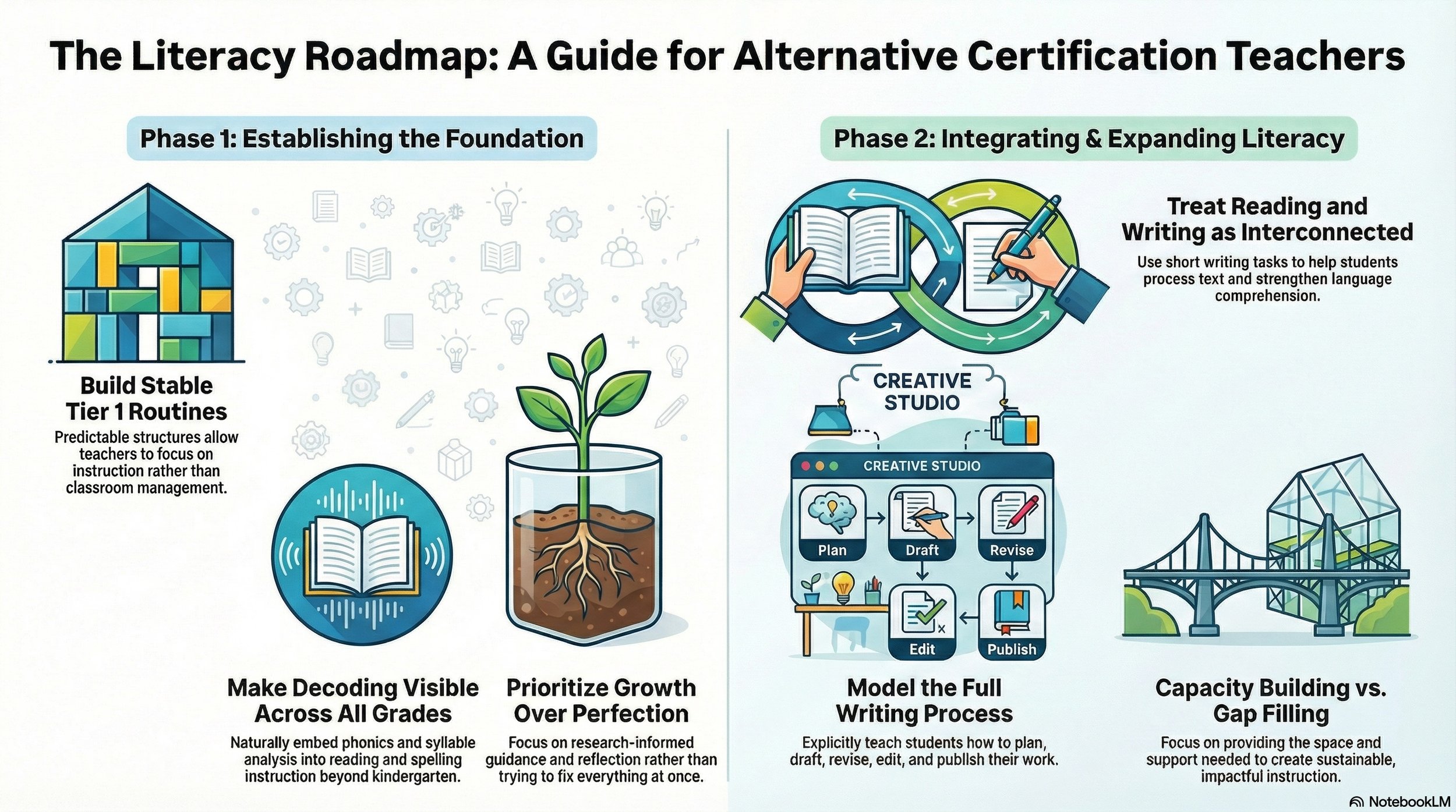
This infographic was made with NotebookLM AI.